Artists and art-material suppliers come together at Pearl
Paint's "Great American Art Event" in New York. "Secrets" here
are bought, sold and given away. Popular instructors
demonstrate "trees, rocks and water" or "fruit, vegetables and
lace," or "how to paint 'itty bitty' paintings," or "how to
master abstraction." With lots of free paint, brushes,
stretched canvas and art boards it's a creative rummage. For
many, the gods are in the equipment. Others come for motivation
or inspiration. Most are looking for techniques to match the
quality of today's materials.
A feeling of entitlement pervades. People are attracted to
making art, and while they may have the idea that a period of
apprenticeship may be necessary in order to develop quality,
they also have the inclination to hold their noses and jump in.
My group completed two or three 11" x 14"s in a day. This while
watching my acrylic demos, looking at my slide shows and
listening to me pontificate. People are introduced to new
systems and they try things they wouldn't normally do. Some of
them screw up. Others excel--you can see them growing in front
of you. It's all part of the game and everybody understands.
Generally speaking, they leave happy.
This business of "bashing them out" has value in and out of the
personal studio. Painters, particularly beginning painters,
need to lose the sense of preciousness about their work. I've
noticed that preciousness often means "stuck." After a lifetime
of wonder it's still a mystery why some people improve and
others don't. Desire, character and even economic pressure are
factors. Talent maybe. Ego and a longing for uniqueness are
also in there somewhere. I look at folks and try to see in them
an "iron will and a butterfly mind." It seems that the
imaginative ones who also work hard ("WF"--Working Flakes) are
the ones who are soon subsidized by this worker's edge. It's
through production itself that people grow. Whether they do it
at a workshop or in a workroom, it's the working habit that
pays for the art supplies--and eventually that big studio with
the panoramic view. To get to that place a certain amount of
sacrifice may be necessary. I've told so many people: "Go to
your room." I've suggested that they go for six months or a
year. To work. To dig around in their potential. To really find
out. This morning, in New York, it may be an illusion but there
seems to be fewer people on the streets.
Best regards,
Robert
PS: "He rose early, worked strenuously, and retired late. He
seemed to forget the ordinary hours for meals and would have to
be called over and over again--unfinished work frequently being
taken in hand just at this time." (Otto Bache on J. M.
Whistler)
Esoterica: The Working Flake efficiently prepares ahead more
than enough supports for her work. The time-line can be an hour
or a life. Bashing them out, one to another, the works develop
and techniques and skills are honed. Some works are honoured
and put under another light. Some become Frisbees. The WF has
the feeling she is the caretaker of a giant personal event
where freshness, understatement and growth are a byproduct. Joy
prevails. Sweat forms. Ideas breed.
Thursday, November 03, 2005

The kids arent all right
OCT. 28 - NOV. 3, 2005
The Kids Aren’t All Right
Is over-education killing young artists?
by AARON ROSE
In the summer of 2004, I got a call from Arty Nelson, who often writes about art for this publication. He had just attended the much-lauded “Supersonic” show. For those who aren’t familiar, “Supersonic” is a large exhibition, now in its second year, that features the work of MFA students from esteemed area programs like CalArts, Art Center, UCLA, etc. When I asked the writer how the show was, he simply said: “The kids aren’t all right.”
Having not yet seen the exhibition, I was more inclined to give the young artists the benefit of the doubt. Considering they were just finishing years of school, I wouldn’t have expected to see the most developed work in the world, but I would still have hoped for something to blow my socks off. After seeing the show, though, I had the same sinking feeling. While the overall installation was impressive and the space at Art Center in Pasadena was amazing, the work left me mostly empty and with a few exceptions seemed like nothing more than a rehash of conceptual ideas that were mined years ago. I was out of town for the 2005 show at the newly renovated L.A. Design Center, but I heard similarly dismal accounts. It made me wonder why, when we live in such a socially and politically volatile time, are these students producing stuff with little or no social relevance when they should be delivering edgy, urgent, thought-provoking work?
For the last 15 years — first as a painter, then as a gallery owner and now as an independent curator, publisher and filmmaker — I have had the good fortune of dealing almost exclusively with young, aspiring artists — artists with chips on their shoulders and fire in their hearts. I have worked with university-trained and self-taught artists. For the last two years an exhibition I co-curated, “Beautiful Losers,” has been on the American museum circuit. The show focuses on a loose-knit group of artists (Chris Johanson, Barry McGee, Margaret Kilgallen, Ryan McGinness, Thomas Campbell, etc.) who came up from the streets and, for the most part, entered the art world through the back door.
Many of the artists in “Losers” have gone from relative obscurity to international renown, and along the way I’ve witnessed all the positive and negative trappings that come with that success. I’ve seen the underground go overground and, in some cases, lose much of its original power and charm. Still though, I have a never-ending hunger for new art created by young artists. In fact, it is the energy of youth that has kept me in the art game so long. In my opinion, it has always been the job of the young artists to shake things up, to throw out old ideas and usher in a new way of thinking. I want to be a part of that.
So why was the “Supersonic” exhibition filled with such uninspired work? I’ll take a stab at trying to answer that here. I should interject that this is not meant to be a rant against any particular artist, educational institution or exhibition. I mention “Supersonic” simply because it represents a larger trend that I have noticed around the country and the world for some time now.
It has always been the function of artists to tell the narrative of our times in a way that isn’t filtered through big-media spin or the historical revisionism of academic pundits. Recent and historical precedence tell us that it should be young people, and particularly the artists among them, who are most passionately voicing this narrative. But they’re not. In fact, there is a critical lack of voice among young artists, and I believe that art schools are to blame for this crisis.
There are quite possibly more quality art schools in and around Los Angeles than anywhere else in the country. These institutions are staffed with amazing talents (Mike Kelley and John Baldessari among them). Legions of creative young people flock to our city every year to work alongside their heroes and develop their talents with hopes of making it as an artist. That’s great; an education, particularly in art history and technique, can be valuable to a young artist, and studying with your heroes can be inspiring. What happens too often in these situations, though, is that we find young artists simply emulating their instructors, rather than finding and honing their own aesthetics and points of view about the world, society, themselves.
In the beginnings of an artist’s career, the power in his or her work should lie not in their technique or knowledge of art history or theory or business acumen, but in what one has to say. Artists might as well hang up their paintbrushes before they even begin if that voice isn’t in place. Ideas and a point of view are the backbones of the artistic process. In fact, L.A. art school gurus such as Kelley and Baldessari were wild cards when they began. Their works were constantly infused with socioeconomic and political agendas that went against the art world’s status quo. In can be argued that it was the rebellious attitudes and iconoclastic positions of those artists’ first works that built their current international success. But now they are part of an art establishment that seems distant to many young people who should be getting inspired by art.
While some may argue to the contrary, contemporary art is not a luxury. I believe it is a necessity. It satisfies not only a visual need, but also an educational and, most importantly, a spiritual need for us. Art should teach us about how we relate to the world. It seems ironic, then, that the curriculum taught in most MFA programs addresses almost everything but fulfilling these needs. Art institutions today work more like business schools than any kind of creative laboratory. As is often the case with such professional schools, the credential has come to mean more than any individual biography or personal point of view. From the creative side, art theory has begun to play such a dominant role in art school that I feel it has lobotomized many young creative minds. Young MFAs are required to read endless texts, many written more than 20 years ago by stuffy Frenchmen with navel-gazing theories holding little or no relevance to life in Bush’s America. They are then asked to somehow relate their work to these deconstructionist theories and then be judged by how successfully they do this.
The primary problem with this kind of education is that by diving deeper and deeper into the theoretical and self-referential, artists lose touch with their public. As a result, the public, particularly the young public, often feels alienated from art. Intentionally or not, people have been made to feel inferior to the art intelligentsia. What inevitably follows is that art becomes simply something to be bought, sold and understood by a very small sector of the population and it loses its urgent role as a means of communication or as a catalyst for social or cultural change.
On more than one occasion I have felt the urge to spray-paint “Mike Kelley is the Enemy” on walls around the city. Nothing against Kelley; his early work in particular was a big inspiration and holds great meaning for me. Rather, I want to do this as a statement to young artists that they need to kill their heroes to discover themselves.
Of course, I’m generalizing. There are many young, emerging artists working today who truly believe in the relevance of what they are doing and have the chops and points of view to back it up. And this isn’t to suggest that all artwork should be political. I believe that a personal statement that is drawn from the heart can be more powerful and effective than propaganda. Works that have inspired me recently include those by Ashley Macomber, a Los Angeles artist who creates intricately painted human/animal hybrids that could be said to resemble those campy American Indian paintings found on truck-stop T-shirts. Upon deeper consultation, however, they provide a strong commentary on our relationships to each other, nature and ourselves. Also of note is the East Coast collective Paperrad, whose multimedia installations include everything from sculpture to animation to printed fanzines. The collective’s innocent yet sophisticated approach to art consistently leaves me feeling hungry for more. Other artists of interest include Masaki Kawai, Matt Leines, Tauba Auerbach, Jim Drain and Jo Jackson. Needless to say there is much good work out there.
Some of these artists are MFAs and some are not. The point of all this is that if young artists had the courage and the encouragement to focus more on their art than the “art business,” there would be even more inspiring work to see and less distance between art and the public. Maybe all it takes is a little less thinking and a lot more feeling. If we could open our hearts amazing things could happen.
The Kids Aren’t All Right
Is over-education killing young artists?
by AARON ROSE
In the summer of 2004, I got a call from Arty Nelson, who often writes about art for this publication. He had just attended the much-lauded “Supersonic” show. For those who aren’t familiar, “Supersonic” is a large exhibition, now in its second year, that features the work of MFA students from esteemed area programs like CalArts, Art Center, UCLA, etc. When I asked the writer how the show was, he simply said: “The kids aren’t all right.”
Having not yet seen the exhibition, I was more inclined to give the young artists the benefit of the doubt. Considering they were just finishing years of school, I wouldn’t have expected to see the most developed work in the world, but I would still have hoped for something to blow my socks off. After seeing the show, though, I had the same sinking feeling. While the overall installation was impressive and the space at Art Center in Pasadena was amazing, the work left me mostly empty and with a few exceptions seemed like nothing more than a rehash of conceptual ideas that were mined years ago. I was out of town for the 2005 show at the newly renovated L.A. Design Center, but I heard similarly dismal accounts. It made me wonder why, when we live in such a socially and politically volatile time, are these students producing stuff with little or no social relevance when they should be delivering edgy, urgent, thought-provoking work?
For the last 15 years — first as a painter, then as a gallery owner and now as an independent curator, publisher and filmmaker — I have had the good fortune of dealing almost exclusively with young, aspiring artists — artists with chips on their shoulders and fire in their hearts. I have worked with university-trained and self-taught artists. For the last two years an exhibition I co-curated, “Beautiful Losers,” has been on the American museum circuit. The show focuses on a loose-knit group of artists (Chris Johanson, Barry McGee, Margaret Kilgallen, Ryan McGinness, Thomas Campbell, etc.) who came up from the streets and, for the most part, entered the art world through the back door.
Many of the artists in “Losers” have gone from relative obscurity to international renown, and along the way I’ve witnessed all the positive and negative trappings that come with that success. I’ve seen the underground go overground and, in some cases, lose much of its original power and charm. Still though, I have a never-ending hunger for new art created by young artists. In fact, it is the energy of youth that has kept me in the art game so long. In my opinion, it has always been the job of the young artists to shake things up, to throw out old ideas and usher in a new way of thinking. I want to be a part of that.
So why was the “Supersonic” exhibition filled with such uninspired work? I’ll take a stab at trying to answer that here. I should interject that this is not meant to be a rant against any particular artist, educational institution or exhibition. I mention “Supersonic” simply because it represents a larger trend that I have noticed around the country and the world for some time now.
It has always been the function of artists to tell the narrative of our times in a way that isn’t filtered through big-media spin or the historical revisionism of academic pundits. Recent and historical precedence tell us that it should be young people, and particularly the artists among them, who are most passionately voicing this narrative. But they’re not. In fact, there is a critical lack of voice among young artists, and I believe that art schools are to blame for this crisis.
There are quite possibly more quality art schools in and around Los Angeles than anywhere else in the country. These institutions are staffed with amazing talents (Mike Kelley and John Baldessari among them). Legions of creative young people flock to our city every year to work alongside their heroes and develop their talents with hopes of making it as an artist. That’s great; an education, particularly in art history and technique, can be valuable to a young artist, and studying with your heroes can be inspiring. What happens too often in these situations, though, is that we find young artists simply emulating their instructors, rather than finding and honing their own aesthetics and points of view about the world, society, themselves.
In the beginnings of an artist’s career, the power in his or her work should lie not in their technique or knowledge of art history or theory or business acumen, but in what one has to say. Artists might as well hang up their paintbrushes before they even begin if that voice isn’t in place. Ideas and a point of view are the backbones of the artistic process. In fact, L.A. art school gurus such as Kelley and Baldessari were wild cards when they began. Their works were constantly infused with socioeconomic and political agendas that went against the art world’s status quo. In can be argued that it was the rebellious attitudes and iconoclastic positions of those artists’ first works that built their current international success. But now they are part of an art establishment that seems distant to many young people who should be getting inspired by art.
While some may argue to the contrary, contemporary art is not a luxury. I believe it is a necessity. It satisfies not only a visual need, but also an educational and, most importantly, a spiritual need for us. Art should teach us about how we relate to the world. It seems ironic, then, that the curriculum taught in most MFA programs addresses almost everything but fulfilling these needs. Art institutions today work more like business schools than any kind of creative laboratory. As is often the case with such professional schools, the credential has come to mean more than any individual biography or personal point of view. From the creative side, art theory has begun to play such a dominant role in art school that I feel it has lobotomized many young creative minds. Young MFAs are required to read endless texts, many written more than 20 years ago by stuffy Frenchmen with navel-gazing theories holding little or no relevance to life in Bush’s America. They are then asked to somehow relate their work to these deconstructionist theories and then be judged by how successfully they do this.
The primary problem with this kind of education is that by diving deeper and deeper into the theoretical and self-referential, artists lose touch with their public. As a result, the public, particularly the young public, often feels alienated from art. Intentionally or not, people have been made to feel inferior to the art intelligentsia. What inevitably follows is that art becomes simply something to be bought, sold and understood by a very small sector of the population and it loses its urgent role as a means of communication or as a catalyst for social or cultural change.
On more than one occasion I have felt the urge to spray-paint “Mike Kelley is the Enemy” on walls around the city. Nothing against Kelley; his early work in particular was a big inspiration and holds great meaning for me. Rather, I want to do this as a statement to young artists that they need to kill their heroes to discover themselves.
Of course, I’m generalizing. There are many young, emerging artists working today who truly believe in the relevance of what they are doing and have the chops and points of view to back it up. And this isn’t to suggest that all artwork should be political. I believe that a personal statement that is drawn from the heart can be more powerful and effective than propaganda. Works that have inspired me recently include those by Ashley Macomber, a Los Angeles artist who creates intricately painted human/animal hybrids that could be said to resemble those campy American Indian paintings found on truck-stop T-shirts. Upon deeper consultation, however, they provide a strong commentary on our relationships to each other, nature and ourselves. Also of note is the East Coast collective Paperrad, whose multimedia installations include everything from sculpture to animation to printed fanzines. The collective’s innocent yet sophisticated approach to art consistently leaves me feeling hungry for more. Other artists of interest include Masaki Kawai, Matt Leines, Tauba Auerbach, Jim Drain and Jo Jackson. Needless to say there is much good work out there.
Some of these artists are MFAs and some are not. The point of all this is that if young artists had the courage and the encouragement to focus more on their art than the “art business,” there would be even more inspiring work to see and less distance between art and the public. Maybe all it takes is a little less thinking and a lot more feeling. If we could open our hearts amazing things could happen.
Monday, October 31, 2005
Spook yourself into action
Boo!
Halloween is the perfect time to spook yourself into art marketing
action.
My coach recently spooked me into action with this question: "What if
you
went into a bookstore and saw your book on the shelf--only it was
written by
someone else?" Eeek! I can't let that happen. It's a question that
keeps me
going with the proposal for my book to help artists with
self-promotions.
Which scenario will spook you into action?
:: You have a terrific venue for a last-minute exhibition, but you
haven't
been updating your mailing list regularly. Sadly, no one comes because
you
didn't have time to send out an invitation.
:: A curator wants to know your exhibition and career history.
Unfortunately, you haven't kept track of the exhibition titles and
locations
for your resume.
:: The local museum would like for you to give a talk about your work,
but
you've n.ever talked about your work. You know you only get one chance
to
make a first impression. If only you had been writing, speaking, and
practicing for such an op.portunity all along.
:: You find out you didn't get into a juried show only because your
slides
were really bad. One of the jurors knew your work, but they had to go
along
with what was sent in and your images, quite frankly, stunk.
:: You missed a sale because you didn't follow up. Later you find out
that
the would-be buyer is a major collector and on the board of the museum.
Not
only that, she knows lot of other buyers!
:: You experience fire/smoke/flood damage and have no in.surance. It's
a
total loss and you have no resources to restart your business.
:: You work and work in your studio. You end up with a terrific body of
work, but no one to share it with because you've stayed to yourself.
And a few questions to haunt you:
What if you don't know your next step?
What if no one sees your art?
What if you don't reach your potential?
. . . . . . . . . . . . . . . . . . . . . . . .
DO THIS! NOT-TOO-TERRIFYING ACTION STEPS TO TAKE
KNOW THIS----------~> Keeping the right question or vision in mind can
be
highly motivating.
THINK ABOUT THIS---~> You're in control. It won't happen without your
action.
DO THIS------------~> Come up with the one question or one vision that
moves
you into action. Type it up in giant letters and post it in your studio
and
next to your computer. Share it with us on the Art Biz Blog:
http://www.artbizblog.com
Halloween is the perfect time to spook yourself into art marketing
action.
My coach recently spooked me into action with this question: "What if
you
went into a bookstore and saw your book on the shelf--only it was
written by
someone else?" Eeek! I can't let that happen. It's a question that
keeps me
going with the proposal for my book to help artists with
self-promotions.
Which scenario will spook you into action?
:: You have a terrific venue for a last-minute exhibition, but you
haven't
been updating your mailing list regularly. Sadly, no one comes because
you
didn't have time to send out an invitation.
:: A curator wants to know your exhibition and career history.
Unfortunately, you haven't kept track of the exhibition titles and
locations
for your resume.
:: The local museum would like for you to give a talk about your work,
but
you've n.ever talked about your work. You know you only get one chance
to
make a first impression. If only you had been writing, speaking, and
practicing for such an op.portunity all along.
:: You find out you didn't get into a juried show only because your
slides
were really bad. One of the jurors knew your work, but they had to go
along
with what was sent in and your images, quite frankly, stunk.
:: You missed a sale because you didn't follow up. Later you find out
that
the would-be buyer is a major collector and on the board of the museum.
Not
only that, she knows lot of other buyers!
:: You experience fire/smoke/flood damage and have no in.surance. It's
a
total loss and you have no resources to restart your business.
:: You work and work in your studio. You end up with a terrific body of
work, but no one to share it with because you've stayed to yourself.
And a few questions to haunt you:
What if you don't know your next step?
What if no one sees your art?
What if you don't reach your potential?
. . . . . . . . . . . . . . . . . . . . . . . .
DO THIS! NOT-TOO-TERRIFYING ACTION STEPS TO TAKE
KNOW THIS----------~> Keeping the right question or vision in mind can
be
highly motivating.
THINK ABOUT THIS---~> You're in control. It won't happen without your
action.
DO THIS------------~> Come up with the one question or one vision that
moves
you into action. Type it up in giant letters and post it in your studio
and
next to your computer. Share it with us on the Art Biz Blog:
http://www.artbizblog.com
Monday, October 24, 2005
Recent Work
Rare for me to post images on this blog, as I usually post them a few other places but thought I might post a few recent images of recent work here.
"Poe" - Award winner

"Dreamland" - Award winner

"Anima Mundi" - Award winner

"Poe" - Award winner

"Dreamland" - Award winner

"Anima Mundi" - Award winner
WIP - Lucky
Boy do I ever need to get myself a DSLR camera, my Sony 5.1 MP point and shoot just isnt cutting it, certainly not when I have to capture artwork. Maybe next year, I have spent waaaaay too much money on new techo toys this year as it is!
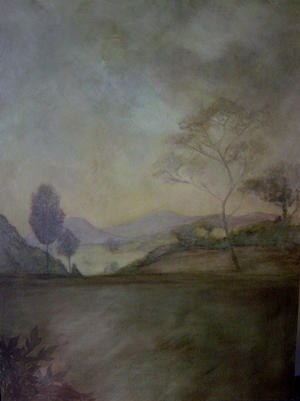
A few images of a project for Painting studio, about a week in. Oil on panel 24 x 32"


A few images of a project for Painting studio, about a week in. Oil on panel 24 x 32"
Sunday, October 23, 2005
Work to do
The title of this entry is the theme of my life since returning to college. I have put off the reading in Modern Art History for the week, and so today I have to get it done, as well as the summary/response that goes with it for the week.
After speaking to a good friend who has the same class, she recommended being more analytical, and is sending me a document that is a nice outline with how to write in a fashion that might be more acceptable to my hard-ass professor, whom I like and respect very much, but am finding it increasingly difficult to know exactly what it is she wants. Whatever it is, I am still trying.
I just want to get to a place where I am not in tears or completely destroyed after class on the drive home on Monday nights. I feel like I am a stupid person after her class, that going back to college at 40 was a mistake, because I am not quick enough to make the theoretical leaps she requires of me.
I am still mulling over if I am going to take to HS classes in the summer to try and catch me up a bit. School is so exhausting (but fun!) that I am already looking forward to my holiday break...perhaps it is because I wish I would have done better on my last big paper in Modern Art History, I got a B, but the amount of time spent and research I put in, I should have gotten an A. I just need to learn how to better in her class, be analytical and weigh everything. It is easier said than done, I wish I had more college level writing under my belt, so maybe I should take that Expository writing in the summer :)
After speaking to a good friend who has the same class, she recommended being more analytical, and is sending me a document that is a nice outline with how to write in a fashion that might be more acceptable to my hard-ass professor, whom I like and respect very much, but am finding it increasingly difficult to know exactly what it is she wants. Whatever it is, I am still trying.
I just want to get to a place where I am not in tears or completely destroyed after class on the drive home on Monday nights. I feel like I am a stupid person after her class, that going back to college at 40 was a mistake, because I am not quick enough to make the theoretical leaps she requires of me.
I am still mulling over if I am going to take to HS classes in the summer to try and catch me up a bit. School is so exhausting (but fun!) that I am already looking forward to my holiday break...perhaps it is because I wish I would have done better on my last big paper in Modern Art History, I got a B, but the amount of time spent and research I put in, I should have gotten an A. I just need to learn how to better in her class, be analytical and weigh everything. It is easier said than done, I wish I had more college level writing under my belt, so maybe I should take that Expository writing in the summer :)
Thursday, October 20, 2005
Catching the Eye
Yesterday Duffy Masterson of Ottawa, Ontario wrote: "I've been
a photographer for longer than I care to mention and have
recently taken up painting in acrylic. I find that all the
subject matter has been expressed through my photography and
not much, if anything, catches my eye for painting. There are
always subjects to paint, but none that I want to paint. My
wife and I are packing up and moving to the B.C. Gulf Islands
in an attempt to spark the creative juices again. Have you ever
run into this kind of block?"
Thanks, Duffy. Your block is called PFS (Photo Familiarity
Syndrome) and it's as common as influenza. Some of us fight it
daily. There are many ways of looking at it and several ways of
dealing with it. Taking photos is a creative act in itself.
Some artists, as they move through their life-images, find that
less and less interests or moves them. As it becomes more
difficult to be surprised by joy in the external world,
reality-based images become used up. The trouble with
photography is that it uses up joy too quickly. Also, by
stealthily teaching dependence, photography can turn out to be
dangerous. Unlike the purist and pre-photographic masters of
landscape--Courbet, Corot, Millet, etc., by visual volume alone
it is possible to become jaded. Moving to a new environment may
not solve the problem. You need to realize that painting can
exploit a different--I didn't say greater--range of feelings
than does photography. Painting, in its most exalted forms, can
bring another kind of creative imagination into the mix. With
painting you have an opportunity to add a unique personal
spin--to put a different kind of style and signature to your
product.
For most of us, photography, in all of its marvelous
manifestations, is one of a number of tools in the kit. An
extreme purgation is to take your photo apparatus and shove it
into a vault for a year. Forget you ever did it. I know it's
tough for those of us who love to look through viewfinders and
are used to collecting images in nanoseconds. In this
deprivation, painting becomes more of a savoured event--a
timely act of deliberation, consideration and contemplation.
Painting becomes less capture and more conception. Worthwhile
subjects begin to appear from nowhere. With independent
painting you move into the lively and mysterious darkroom of
your own mind. In this place something else again is sure to
catch your eye.
Best regards,
Robert
PS: "The expression of beauty is in direct ratio to the power
of conception the artist has acquired." (Gustave Courbet)
Esoterica: "What do I want to paint?" is not only the main
question, it's perhaps the only question. Many painters find
they bump along and somehow inadvertently touch on a "hot spot"
where an idea or a motif suddenly gels. It's important that
these golden occasions are recognized and noted. The artist
pauses and looks around for related and peripheral ideas that
can also be exploited. It's often in this "second generation"
where the most involving and exciting work is done. "Paintings
come out of themselves," said the great Canadian landscape
painter Lawren Harris. "The idea," said Damien Hirst, "is more
important than the object."
a photographer for longer than I care to mention and have
recently taken up painting in acrylic. I find that all the
subject matter has been expressed through my photography and
not much, if anything, catches my eye for painting. There are
always subjects to paint, but none that I want to paint. My
wife and I are packing up and moving to the B.C. Gulf Islands
in an attempt to spark the creative juices again. Have you ever
run into this kind of block?"
Thanks, Duffy. Your block is called PFS (Photo Familiarity
Syndrome) and it's as common as influenza. Some of us fight it
daily. There are many ways of looking at it and several ways of
dealing with it. Taking photos is a creative act in itself.
Some artists, as they move through their life-images, find that
less and less interests or moves them. As it becomes more
difficult to be surprised by joy in the external world,
reality-based images become used up. The trouble with
photography is that it uses up joy too quickly. Also, by
stealthily teaching dependence, photography can turn out to be
dangerous. Unlike the purist and pre-photographic masters of
landscape--Courbet, Corot, Millet, etc., by visual volume alone
it is possible to become jaded. Moving to a new environment may
not solve the problem. You need to realize that painting can
exploit a different--I didn't say greater--range of feelings
than does photography. Painting, in its most exalted forms, can
bring another kind of creative imagination into the mix. With
painting you have an opportunity to add a unique personal
spin--to put a different kind of style and signature to your
product.
For most of us, photography, in all of its marvelous
manifestations, is one of a number of tools in the kit. An
extreme purgation is to take your photo apparatus and shove it
into a vault for a year. Forget you ever did it. I know it's
tough for those of us who love to look through viewfinders and
are used to collecting images in nanoseconds. In this
deprivation, painting becomes more of a savoured event--a
timely act of deliberation, consideration and contemplation.
Painting becomes less capture and more conception. Worthwhile
subjects begin to appear from nowhere. With independent
painting you move into the lively and mysterious darkroom of
your own mind. In this place something else again is sure to
catch your eye.
Best regards,
Robert
PS: "The expression of beauty is in direct ratio to the power
of conception the artist has acquired." (Gustave Courbet)
Esoterica: "What do I want to paint?" is not only the main
question, it's perhaps the only question. Many painters find
they bump along and somehow inadvertently touch on a "hot spot"
where an idea or a motif suddenly gels. It's important that
these golden occasions are recognized and noted. The artist
pauses and looks around for related and peripheral ideas that
can also be exploited. It's often in this "second generation"
where the most involving and exciting work is done. "Paintings
come out of themselves," said the great Canadian landscape
painter Lawren Harris. "The idea," said Damien Hirst, "is more
important than the object."
Subscribe to:
Posts (Atom)
